

Currently Empty: 0 CFA
MOTIVATION
What Lies Beyond Impossible? Exploring the Limits We Once Believed
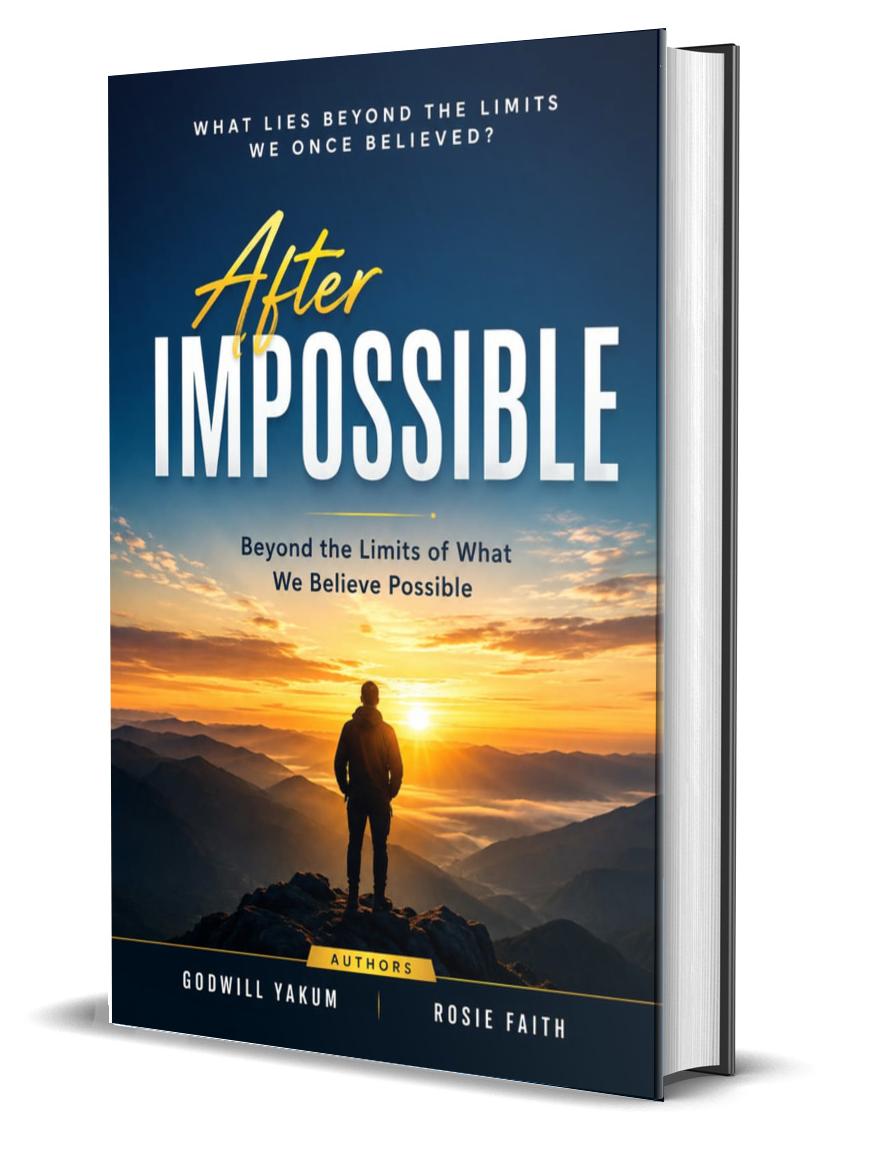
AFTER IMPOSSIBLE
What Lies Beyond the Limits We Once Believed?
What if some of the things we call impossible are not impossible at all—but simply beyond what we currently know, understand, or know how to do?
There are limits we encounter in life that are unquestionably real. There are also limits we accept simply because we have never questioned them.
Between the two lies one of the most important questions we can ask:
How do we know where possibility ends?
This is the question at the heart of AFTER IMPOSSIBLE, a thought-provoking book by Godwill Yakum and Rosie Faith that explores human possibility, limitation, uncertainty, growth, failure, and the boundaries we often accept without examining them.
The Problem With the Word “Impossible”
The word impossible sounds definitive.
When we say that something is impossible, we often believe we are describing reality. But sometimes, what we are really describing is the limit of our current knowledge, experience, resources, confidence, or ability.
There is an important difference between saying:
“This cannot be done.”
and saying:
“I do not yet know how this can be done.”
The two statements may sound similar, but they lead to very different ways of thinking.
AFTER IMPOSSIBLE does not ask readers to believe that everything is possible. It does not promote blind optimism or suggest that determination can overcome every physical, ethical, financial, social, or circumstantial limitation.
Instead, it asks readers to become more careful about the conclusions they reach.
Some boundaries are real.
Some are temporary.
Some are inherited.
Some are created by circumstances.
And some may simply represent the edge of what we currently understand.
A Journey Beyond Accepted Limits
Across twelve chapters and four parts, AFTER IMPOSSIBLE follows a journey that begins with the limits we inherit and ends with the possibilities created when those limits are questioned, tested, and sometimes crossed.
The book begins by examining what we think is impossible.
Why do we accept certain limitations as facts? Why do we sometimes measure our future by what we are capable of doing today? And how often do we mistake our current circumstances for a permanent definition of who we are?
It then turns inward.
Fear can keep possibilities hidden long before we ever investigate them. The familiar can feel safer than the unknown, even when the unknown may contain opportunities for growth.
This leads to a deceptively simple question:
How do you know you can’t?
Not every answer will be “You can.”
Sometimes the evidence will confirm that a boundary is real.
But sometimes the honest answer is:
“I don’t know yet.”
That distinction can change what happens next.
Possibility Requires More Than Belief
One of the central ideas of AFTER IMPOSSIBLE is that possibility does not become reality through belief alone.
Wanting something is not the same as being capable of achieving it.
Imagination is not the same as evidence.
Courage is not the absence of risk.
And persistence is not the same as repeatedly doing the same thing and expecting a different result.
Meaningful progress requires learning, experimentation, preparation, adaptation, resources, discipline, and sometimes failure.
This is why the book treats failure not as a final verdict, but as something that can provide evidence.
A failed attempt may reveal a flawed strategy, an incorrect assumption, a missing skill, insufficient preparation, poor timing, or circumstances that were beyond a person’s control.
Failure does not automatically mean that the goal was impossible.
But neither does failure automatically mean that success is guaranteed.
The challenge is learning how to interpret what happened.
Becoming Capable of What Once Seemed Impossible
Eventually, the question changes.
Instead of asking only:
“Can I do this?”
we begin asking:
“What would I need to become capable of doing this?”
That is a more productive question.
Capability can be developed through knowledge, practice, mentorship, discipline, experience, technology, collaboration, and access to the right resources.
The person who cannot do something today is not necessarily the person who will be unable to do it tomorrow.
At the same time, growth requires honesty. Becoming capable does not mean pretending that limitations do not exist. It means understanding what is required to move beyond the limitations that can genuinely be changed.
When the Impossible Becomes Possible
Perhaps the most significant transformation happens when something once considered impossible is finally demonstrated.
At that moment, the question changes.
It is no longer:
“Can it be done?”
It becomes:
“How can it be done?”
A breakthrough does more than solve a single problem. It can change the starting point for everyone who comes afterward.
What once required extraordinary effort can eventually become ordinary.
What once required a pioneer can become a pathway.
What once seemed unimaginable can become the foundation for the next possibility.
That is why the book ultimately moves beyond individual achievement.
The possibilities we create today can become the opportunities someone else inherits tomorrow.
What Comes After Impossible?
The title of the book is also its final question.
What happens after a boundary is crossed?
The answer is not that all boundaries disappear.
New questions emerge.
New challenges appear.
New limits become visible.
The horizon moves.
Every generation inherits possibilities created by the generations before it. Roads, technologies, knowledge, institutions, discoveries, and ideas become starting points for people who did not have to begin from zero.
In this sense, progress is not simply about going farther.
It is also about moving the starting line for those who come next.
A Book About Questioning More Carefully
AFTER IMPOSSIBLE is ultimately an invitation to think more carefully about the boundaries we accept.
It asks readers to examine the assumptions behind statements such as:
“I can’t.”
“It has never been done.”
“People like me don’t do that.”
“There is no way.”
Rather than replacing those statements with blind optimism, the book encourages a better process:
Examine.
Question.
Learn.
Test.
Adapt.
Discover.
Because sometimes the answer really is that something cannot be done.
But sometimes the answer is:
Not yet.
And sometimes, beyond the boundary we assumed was final, there is an entirely different horizon waiting to be discovered.
AFTER IMPOSSIBLE
What Lies Beyond the Limits We Once Believed?
By Godwill Yakum & Rosie Faith
Perhaps the limit is real.
Or perhaps it is simply where our understanding ends.