

Currently Empty: 0 CFA
Leadership
The Night of a CEO
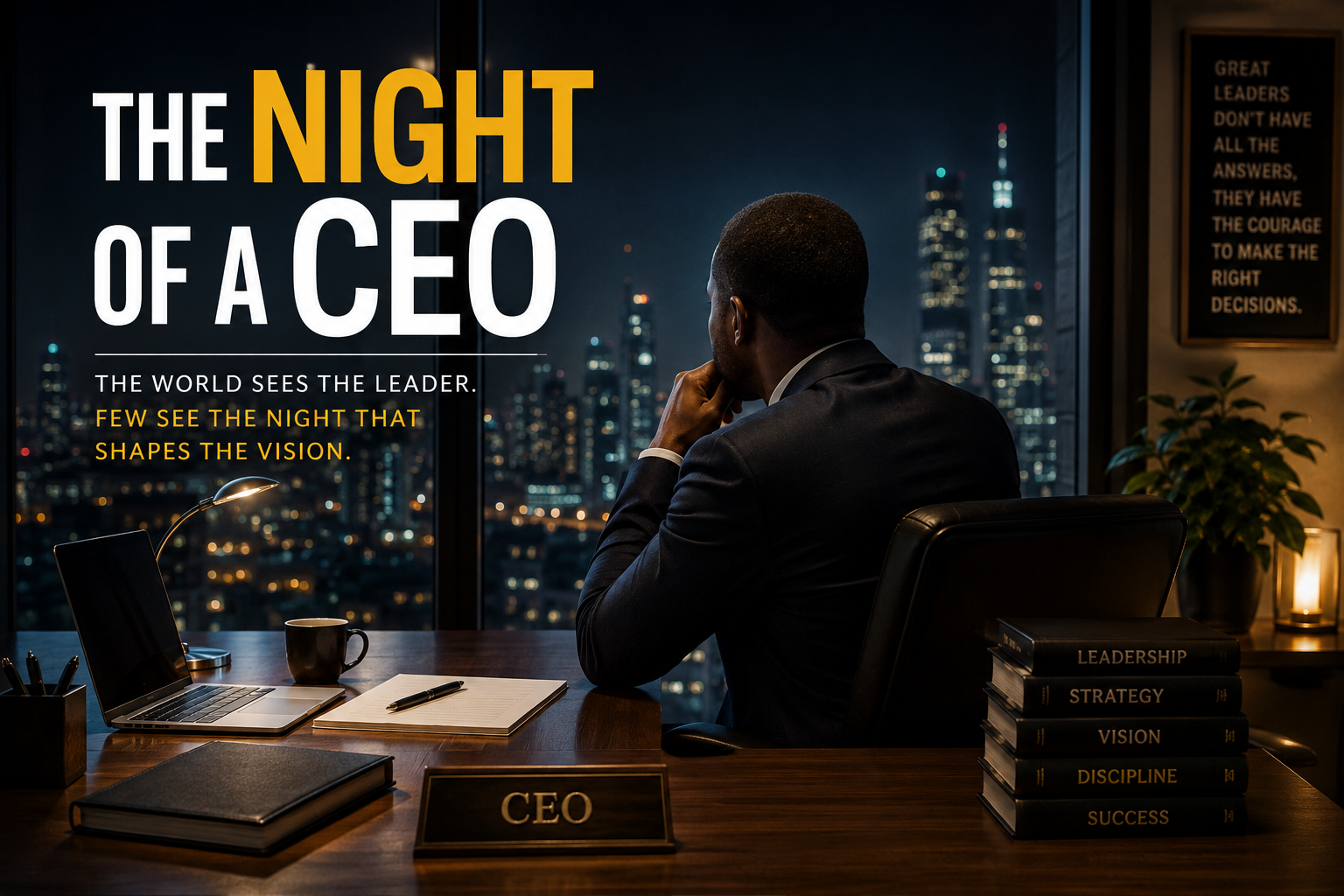
THE NIGHT OF A CEO
The world sees the leader. Few see the night that shapes the vision.
During the day, a CEO looks busy.
Meetings. Calls. Decisions. Deadlines. Strategy. People. Problems. Opportunities.
There is always something to do and someone waiting for an answer.
There are people who need direction, problems that need solutions, decisions that cannot be postponed, and a vision that must continue moving forward.
From the outside, it may look like leadership is about having authority.
But when the night comes, you discover something different.
The office becomes quiet.
The meetings are over.
The phones become less demanding.
The employees have gone home.
The noise disappears.
And suddenly, the CEO is alone.
Not necessarily alone because there are no people around, but alone with thoughts that cannot always be shared.
This is the night of a CEO.
WHEN EVERYONE GOES HOME
One of the most misunderstood realities of leadership is what happens after everyone else has finished their day.
Employees go home.
Teams disconnect.
Meetings end.
But the responsibility does not necessarily end with the working hours.
The CEO may still be thinking.
Thinking about the organization.
Thinking about the people.
Thinking about tomorrow.
Thinking about the decision that was made today.
Thinking about the opportunity that was missed.
Thinking about the opportunity that must be pursued.
And sometimes, thinking about whether the vision is actually becoming reality.
The world may see the CEO sitting in a comfortable office.
But the CEO may be sitting there carrying the weight of an entire organization.
THE QUESTIONS OF THE NIGHT
There are questions that are rarely asked during a board meeting.
They come when everything becomes quiet.
Did I make the right decision?
Are we moving fast enough?
Am I building the right team?
What am I missing?
What should I have done differently?
Can this vision become everything I believe it can become?
These questions do not always have immediate answers.
And that is one of the realities of leadership.
A CEO is not someone who has every answer.
A CEO is someone who must have the courage to keep moving even when every answer is not yet available.
Leadership is often the ability to make a decision with the information available today while accepting that tomorrow may require you to learn, adjust and make another decision.
THE WEIGHT OF PEOPLE
An organization is not merely buildings, programs, products, numbers or systems.
It is people.
Behind every employee is a family.
Behind every student is a dream.
Behind every client is an expectation.
Behind every partner is a relationship.
Behind every team member is someone trusting the organization to provide direction, opportunity or stability.
That reality can make leadership deeply personal.
When an organization succeeds, many people celebrate.
When an organization struggles, many people look toward the person at the top.
That is the nature of leadership.
The CEO may receive the recognition when things go well, but must also carry responsibility when things go wrong.
And sometimes, the hardest part is knowing that your decisions affect people beyond yourself.
THE LONELINESS OF DECISION-MAKING
Leadership does not mean making every decision alone.
Wise CEOs build teams, seek advice, listen to experts and surround themselves with competent people.
But there are moments when the final decision still belongs to the person at the top.
And that can be lonely.
You can ask for advice.
You can listen to different perspectives.
You can study the numbers.
You can consult your team.
But eventually, someone has to say:
“This is what we are going to do.”
That person is often the CEO.
And when the decision is difficult, the weight of that responsibility can follow the CEO into the night.
THE FEAR THAT PEOPLE DON’T SEE
Leadership does not make a person immune to fear.
A CEO can have a vision and still have doubts.
A CEO can be confident and still have questions.
A CEO can be courageous and still be afraid of failure.
The difference is that leadership demands that you do not allow fear to become the architect of your decisions.
Courage is not the absence of fear.
Sometimes courage is simply deciding to move forward despite uncertainty.
There are nights when a CEO must remind himself why the journey began in the first place.
Why was this organization created?
What problem was it created to solve?
Whose life is supposed to be changed?
What future is being built?
Those questions can become fuel.
THE PRICE OF THE VISION
Every meaningful vision has a price.
Sometimes the price is time.
Sometimes it is comfort.
Sometimes it is financial sacrifice.
Sometimes it is missed opportunities.
Sometimes it is choosing the organization’s future over immediate personal gratification.
And sometimes, the price is simply the willingness to keep going when there is no applause.
People often celebrate the visible results of leadership.
They see the successful launch.
They see the new building.
They see the growing organization.
They see the awards.
They see the photographs.
But they may never see the nights that came before those moments.
They may never know how many times the leader questioned the process.
They may never know how many plans had to be rewritten.
They may never know how many disappointments had to be absorbed without allowing them to destroy the vision.
Success has a public side.
But building success often has a very private side.
THE CEO MUST ALSO GROW
One of the greatest dangers of leadership is believing that because you have become the CEO, you have arrived.
You have not.
The position may have changed.
The responsibility may have increased.
The title may have become bigger.
But the learning must continue.
The organization cannot consistently grow beyond the capacity of its leadership.
Therefore, the CEO must keep growing.
Reading.
Learning.
Listening.
Reflecting.
Building relationships.
Studying the industry.
Understanding people.
Improving systems.
Developing emotional maturity.
Learning from mistakes.
And sometimes, simply sitting quietly and asking:
“What must I become to lead this organization into its next season?”
That question may be more important than:
“What must the organization become?”
Because before the organization can enter a new level, its leadership must be prepared for that level.
THE NIGHT IS ALSO WHERE VISION IS REFINED
There is something powerful about silence.
During the day, there are opinions everywhere.
Everyone has an idea.
Everyone has a suggestion.
Everyone has a problem.
Everyone wants something.
But at night, when the noise becomes quieter, the leader has an opportunity to think deeply.
This is where ideas are refined.
Plans are reconsidered.
Priorities are rearranged.
Mistakes are examined.
New possibilities emerge.
The night can become a classroom for leadership.
Not because darkness automatically produces wisdom, but because silence creates room for reflection.
And reflection is essential for anyone responsible for leading others.
TOMORROW WILL COME
Eventually, the night ends.
The sun rises.
The office opens again.
The phones begin ringing.
People return.
Meetings resume.
The problems are still there.
The opportunities are still there.
And the CEO must stand up and lead again.
That is perhaps one of the most remarkable things about leadership.
You can have a difficult night and still show up the next morning.
You can have unanswered questions and still provide direction.
You can experience disappointment and still encourage your team.
You can be uncertain about some things and still remain committed to the vision.
You can be tired and still remember why you started.
That is leadership.
Not perfection.
Not the absence of problems.
But the willingness to continue carrying responsibility while becoming better equipped to carry it.
THE WORLD SEES THE TITLE
People often see the letters CEO and imagine power.
But behind those three letters can be responsibility, sacrifice, uncertainty, pressure, learning, failure, hope and vision.
The CEO is not simply the person sitting at the top of an organizational chart.
The CEO is often the person who must keep thinking about tomorrow while everyone else is focused on today.
And perhaps that is why some of the most important work of a CEO happens when nobody is watching.
When the office is quiet.
When the lights are dim.
When the city outside is still moving.
When the laptop is open but the work has temporarily stopped.
When there is finally enough silence to think.
That is the night of a CEO.
It is the night of questions.
The night of reflection.
The night of responsibility.
The night of vision.
The night of preparation.
And sometimes, the night of courage.
Because when morning comes, the world will not ask how difficult the night was.
The world will simply expect the leader to rise and lead.
And so, the CEO rises.
Not because everything is figured out.
Not because there are no challenges.
Not because there is no fear.
But because the vision is still alive.
And as long as the vision is alive, there is still work to do.
The world sees the leader during the day.
But sometimes, the leader is made at night.
— Godwill Yakum