

Currently Empty: 0 CFA
Beizeh Sonia — Personal Development
Fighting Mediocrity: The Offense vs. Defense Mindset Shift
Fighting Mediocrity: The Offense vs. Defense Mindset Shift
Most people don’t fall into mediocrity. They defend their way into it.
It rarely looks like laziness. It looks like a person who’s found a level of comfort and has quietly decided to guard it — not against real threats, but against the discomfort of change itself. They call it stability. They call it being realistic. They call it “just where I am right now.” But underneath the language of contentment is a defensive crouch, a posture built entirely around protecting what already exists, rather than reaching for what could exist instead.

This is the real engine of mediocrity. Not a lack of ability. Not bad luck. A quiet, constant defense of the status quo.
Core Distinction: Defense Vs. Offense
Every day, in ways large and small, you’re making a choice between two postures.
Defense looks like justifying, explaining or protecting a position. It’s the mental work of convincing yourself and everyone around you, that where you currently stand is fine, is enough, doesn’t need to change. Defense is exhausting in a specific way: it burns energy holding a line instead of moving one.
Offense looks like pursuit. It’s actively pushing toward growth, even when and especially when your current comfort is on the line. Offense doesn’t ask permission from your fears. It doesn’t wait until the ground feels safe. It moves anyway.
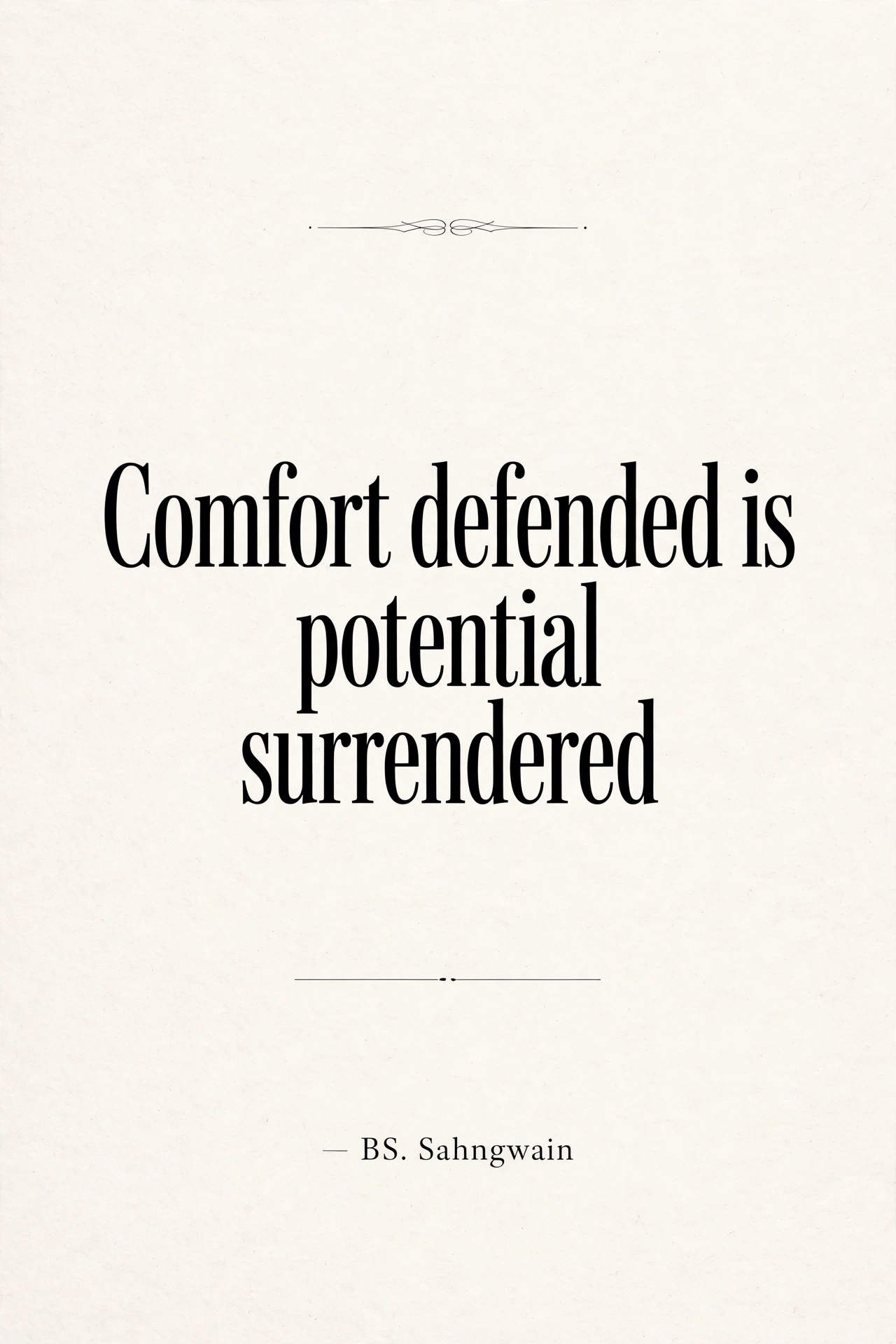
Here’s the line worth underlining: never defend your current situation just to stay comfortable. Comfort defended is potential surrendered. Every hour spent justifying where you are is an hour not spent moving forward.
Below are six principles that fight mediocrity, and they aren’t abstract virtues. Each one is a specific place where people quietly switch from offense to defense and a specific way to switch back.
Principles
#1 Maximize What You’ve Been Given
The offensive move here is simple: take whatever talent, resource, or starting point you actually have, and turn it into forward motion. Not the talent you wish you had. Not the resources someone else was given. What’s actually in your hands, right now.
The defensive trap is the quiet, reasonable-sounding excuse, like “I don’t have enough to work with.” It sounds like humility. It sounds like self-awareness. But functionally, it’s a justification for not advancing. A way of defending inaction by blaming the tools instead of the effort. Mediocrity rarely comes from a shortage of talent. It comes from a talent that was never fully used, because using it fully felt riskier than sitting on it.
#2 Persistence and Endurance
Offense isn’t a single sprint. It’s sustained pressure applied over time — staying on the attack long after the initial burst of motivation has worn off, long after the first plateau shows up.
This is where persistence gets confused with its defensive twin: stubbornness. Persistence keeps advancing through resistance. Stubbornness digs in to protect a position (often a bad or just a not so good one) and calls it commitment. The difference isn’t visible from the outside; both look like “not giving up.” But one is still moving, and the other has just found a more socially acceptable way to stand still.
#3 Own Your Time
Every hour either pushes something forward or holds a line in place. There’s no neutral hour.
The offensive move is treating time as ammunition. Spending it deliberately on what advances you. The defensive trap is subtler: busywork, time-fillers, procrastination dressed up as productivity. These feel active. They feel like something is happening. But they’re really just a way of occupying the field without gaining any ground.
A useful, uncomfortable question to ask before starting almost anything: “does this activity move me forward, or just occupy me?” Most time-fillers can’t survive that question being asked honestly.
#4 Honesty as Fuel
You can’t attack a position you refuse to see clearly. The offensive move is brutal self-assessment. Looking directly at where you actually stand, without softening it, because that honest assessment is what gives you something real to move against.
The defensive trap is self-deception. “I’m doing fine. This is fine.” It’s the single most effective justification move available, because it doesn’t just excuse inaction. It removes the need for action entirely. If nothing’s wrong, there’s nothing to fix. This is exactly the posture that lets mediocrity go unchallenged indefinitely. Honesty isn’t harsh for its own sake. It is the thing that puts you back on offense by giving you a real target.
#5 Decisiveness
Offense requires committing to a direction, even when the ground ahead is uncertain. You move, you adjust, you correct course, but you move.
The defensive trap is indecision wearing the mask of caution. It looks wise. It looks careful. “I just want to think it through a little more” can be true, or it can be a stalling tactic that lets you avoid ever risking anything at all. Indecision is a hidden vote for staying exactly where you are, cast over and over, disguised as prudence.
#6 Release the Past, Reach Forward
The offensive move is always aimed ahead, reaching for a higher calling, a bigger version of the work, a next step that hasn’t been taken yet.
The defensive trap is nostalgia and regret, in either direction. Replaying old wins keeps you defending a version of yourself that already happened. Replaying old failures keeps you defending the story that you can’t do better. Both are a way of guarding old ground instead of taking new ground. The past, either way you dress it up, is still just a position and defending it costs you the same thing every other defensive posture costs: forward motion.
The Same Move, Six Times
Look closely at all six principles and you’ll notice they’re not really six separate ideas. They’re the same move, repeated in six different arenas — talent, time, endurance, honesty, decisions, and history. In every case, mediocrity shows up first as a justification, and excellence shows up first as a refusal to accept that justification.
Comfort defended is potential surrendered. That’s the whole argument, restated in one line.
So here’s the only question that actually matters: what are you currently defending that you should be attacking?
More Articles
Why Discipline Feels So Hard – 6 Simple Reasons You are Missing