

Currently Empty: 0 CFA
Education
Best Study Method to Improve Retention
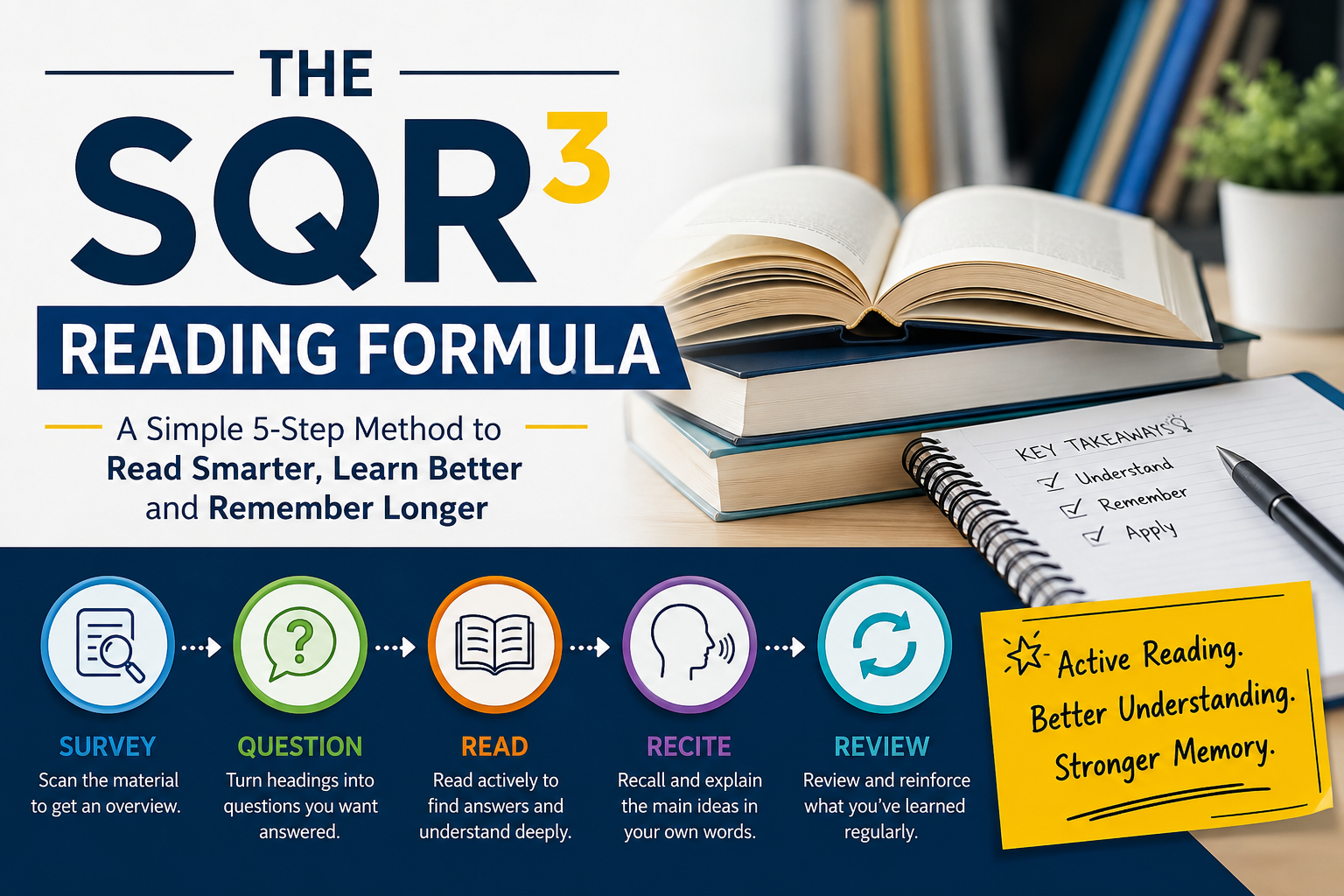
The SQR³ Reading Formula: A Proven Method to Improve Reading Comprehension and Retention
What Is the SQR³ Reading Formula?
The SQR³ Reading Formula is a highly effective reading and study technique designed to improve reading comprehension, information retention, and critical thinking. The acronym SQR³ stands for Survey, Question, Read, Recite, and Review—five systematic steps that transform passive reading into an active learning experience.
Whether you’re a student, educator, researcher, or lifelong learner, the SQR³ method helps you understand complex material faster, retain information longer, and recall key concepts with greater confidence.
Why the SQR³ Reading Formula Matters
Many people read without fully absorbing the information. The SQR³ method solves this problem by encouraging readers to engage with the text before, during, and after reading.
Key Benefits of the SQR³ Method
- Improves reading comprehension
- Enhances long-term memory retention
- Increases focus and concentration
- Encourages active learning
- Strengthens critical thinking skills
- Makes studying more efficient
- Boosts confidence during exams and presentations
The Five Steps of the SQR³ Reading Formula
1. Survey
The first step is to survey the material before reading it in detail. Instead of diving straight into the text, take a few minutes to gain an overview of the content.
During this stage, examine:
- The title and subtitles
- Chapter headings
- Section summaries
- Images, charts, and diagrams
- Bold or italicized terms
- Introduction and conclusion
Purpose
Surveying creates a mental framework that prepares your brain to process new information more effectively.
2. Question
After surveying the material, convert headings and major topics into meaningful questions. This gives your reading a clear objective and stimulates curiosity.
For example:
- What is the author’s main argument?
- Why is this concept important?
- How does this process work?
- What evidence supports this idea?
Purpose
Reading with questions in mind keeps you actively engaged and improves comprehension because your brain is searching for specific answers.
3. Read
Now read the material carefully with the goal of answering the questions you created.
As you read:
- Identify the main ideas
- Understand supporting details
- Highlight important concepts
- Take concise notes
- Mark unfamiliar terms for further research
Avoid rushing through the content. Focus on understanding rather than simply finishing the text.
Purpose
Active reading improves comprehension and helps you distinguish essential information from less important details.
4. Recite
Once you’ve finished a section, stop reading and explain the key ideas in your own words without looking at the text.
You can:
- Summarize aloud
- Write a brief summary
- Teach someone else
- Answer your earlier questions from memory
Purpose
Recitation uses active recall, one of the most effective techniques for strengthening memory and identifying knowledge gaps.
5. Review
The final step is to review everything you’ve learned. Revisit your notes, summaries, and questions to reinforce the information.
Effective review strategies include:
- Reviewing notes within 24 hours
- Creating flashcards
- Testing yourself regularly
- Summarizing key concepts
- Connecting new knowledge with existing understanding
Purpose
Regular review transfers information from short-term memory into long-term memory, making it easier to recall when needed.
How the SQR³ Method Improves Learning
The SQR³ Reading Formula is based on the principle that learning is most effective when readers actively engage with information instead of passively consuming it. By combining previewing, questioning, focused reading, active recall, and spaced review, the method significantly improves understanding and long-term retention.
This structured approach also reduces cognitive overload by breaking the reading process into manageable stages, making it especially valuable for academic, professional, and personal learning.
Best Situations to Use the SQR³ Reading Formula
The SQR³ method is suitable for a wide range of reading materials, including:
- Textbooks
- Academic journals
- Research papers
- Business reports
- Professional training manuals
- Online courses
- Non-fiction books
- Educational articles
It is particularly effective when studying subjects that require deep understanding and long-term recall.
Tips for Getting the Best Results
To maximize the effectiveness of the SQR³ Reading Formula:
- Study in a distraction-free environment.
- Set clear reading goals before you begin.
- Take short breaks during extended reading sessions.
- Review your notes regularly.
- Apply what you’ve learned through discussion or practice.
- Make the SQR³ method part of your daily study routine.
Conclusion
The SQR³ Reading Formula is more than a reading strategy—it’s a comprehensive learning system that helps readers engage deeply with information, improve comprehension, and retain knowledge for the long term. By following the five simple steps—Survey, Question, Read, Recite, and Review—you can transform the way you read, study, and learn.
Whether you’re preparing for exams, conducting research, or developing professional expertise, adopting the SQR³ method will make your reading sessions more focused, productive, and rewarding.