

Currently Empty: 0 CFA
Education
How to Read and Not Forget: 10 Proven Study Techniques
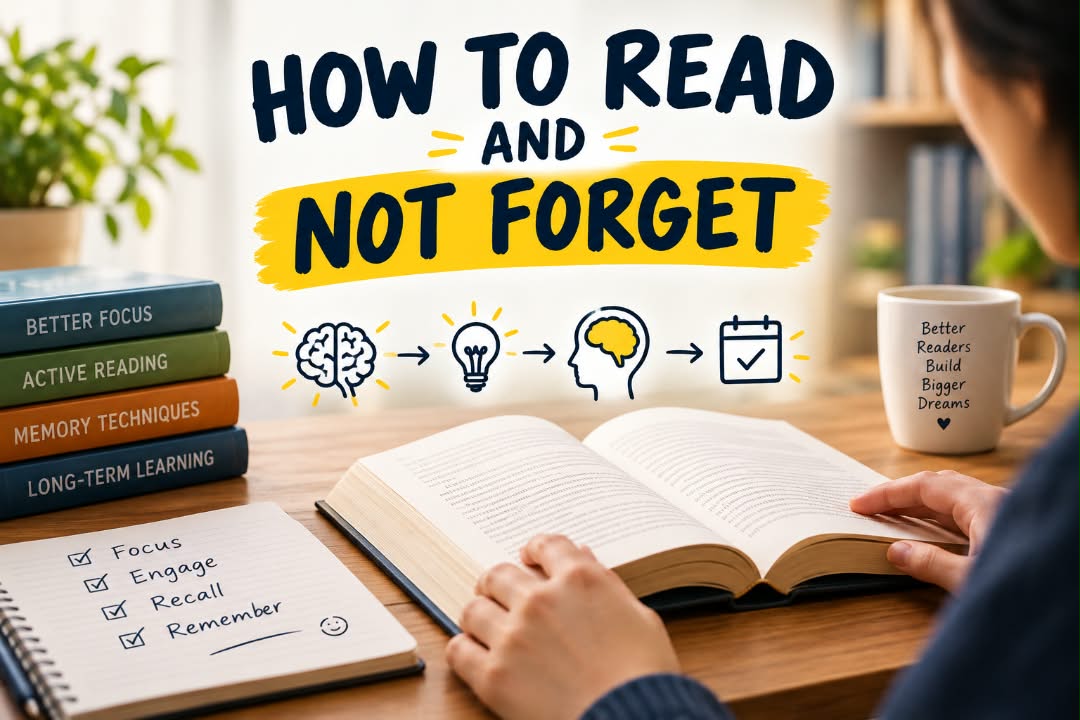
How to Read and Not Forget: 10 Proven Study Techniques for Students
Have you ever spent hours reading a lesson, only to realize a few days later that you can barely remember what you studied?
You are not alone.
Many students believe that studying means reading the same material repeatedly. Unfortunately, reading more does not always mean remembering more.
The real secret is not simply to read harder. It is to read smarter.
Whether you are preparing for the GCE, BAC, BEPC, HND, university examinations or a competitive entrance examination, learning how to retain information can significantly improve your academic performance.
In this article, we explore practical techniques that can help you read and remember what you study for longer.
Why Do Students Read and Forget?
Before learning how to improve your memory, it is important to understand why forgetting happens.
One common reason is passive reading.
A student may read several pages while highlighting sentences or moving their eyes across the text without actively thinking about the information.
Another problem is cramming.
Studying an entire chapter for several hours the night before an examination may give you the feeling that you know the material, but much of that information can quickly disappear from memory.
Other causes include:
- Lack of concentration
- Studying for too long without breaks
- Poor understanding of the subject
- Lack of revision
- Trying to memorize everything word-for-word
- Studying in a distracting environment
- Lack of sleep
- Failure to practise what has been learned
The good news is that these problems can be addressed.
1. Understand Before You Try to Memorize
One of the most effective ways to remember something is to understand it first.
Do not immediately try to memorize every sentence in your textbook.
Ask yourself:
What does this mean?
Why is it important?
How does it relate to what I already know?
For example, if you are studying Constitutional Law, do not simply memorize definitions. Try to understand the principles behind them and how they apply to real situations.
Understanding creates connections in your mind, making information easier to recall later.
2. Read With a Purpose
Never begin studying without knowing what you want to accomplish.
Instead of saying:
“I am going to study Economics.”
Set a specific objective:
“I will understand the causes of inflation and be able to explain five of them without looking at my notes.”
A clear objective gives your brain something specific to focus on.
At the end of the session, test yourself against that objective.
3. Use Active Recall
One of the most powerful study techniques is active recall.
Active recall means trying to retrieve information from your memory instead of simply reading it again.
After reading a section, close your book and ask yourself:
- What did I just learn?
- What are the main points?
- Can I explain this concept without looking?
- What examples can I give?
- What questions could appear in an examination?
If you cannot explain the concept, go back to your notes, review it and try again.
The effort of remembering strengthens your ability to remember.
4. Teach What You Have Learned
A powerful way to discover whether you truly understand something is to teach it to someone else.
You can explain the topic to:
- A classmate
- A friend
- A sibling
- A study partner
- Or even yourself
Pretend that you are the teacher.
Explain the topic using simple language.
If you become stuck while explaining, that may indicate that you do not fully understand that part yet.
This technique is often associated with the Feynman Technique: simplify a concept until you can explain it clearly.
5. Use Spaced Repetition
Do not wait until examination week before revising.
Instead, review your lessons at increasing intervals.
For example:
Day 1: Learn the topic
Day 2: Review it
Day 4: Test yourself
Day 7: Review again
Day 14: Test yourself again
Day 30: Final review
This approach is called spaced repetition.
It helps move information from short-term memory toward stronger long-term retention.
For examination students, this can be much more effective than trying to memorize an entire syllabus in a few days.
6. Take Short, Effective Study Sessions
Studying for five or six hours continuously does not necessarily make you more productive.
Your concentration can decline when you study for too long without meaningful breaks.
Instead, divide your study time into focused sessions.
For example:
45 minutes of focused study → 10 minutes break → 45 minutes study
During the study period, eliminate unnecessary distractions.
Put your phone away if you do not need it for learning.
The goal is not to spend the most hours studying.
The goal is to make the hours you study count.
7. Write Short Summaries
After studying a topic, write a short summary using your own words.
Do not copy the entire textbook.
Ask yourself:
“If I had only one minute to explain this topic, what would I say?”
Your summary should contain the essential ideas, definitions, examples, formulas or key arguments.
This forces you to identify what is actually important.
8. Practise With Questions
If you are preparing for an examination, reading alone is not enough.
You need to practise answering questions.
After studying a topic, find or create questions based on it.
Try answering them without looking at your notes.
For subjects such as Mathematics, Economics, Law, Sciences and other examination-based disciplines, practice can reveal weaknesses that ordinary reading may hide.
The more you practise retrieving information, the more confident you become when facing examination questions.
9. Connect New Information to What You Already Know
Your brain remembers information better when it has something to connect it to.
Suppose you are learning a new concept.
Ask:
What does this remind me of?
Have I studied something similar before?
Can I create an example from everyday life?
How does this relate to another topic?
The more meaningful connections you create, the easier it becomes to retrieve the information later.
10. Sleep and Take Care of Your Brain
Sometimes students try to solve memory problems by studying longer.
But your brain also needs adequate rest.
Sleep plays an important role in learning and memory.
Instead of staying awake all night trying to memorize your entire syllabus, develop a consistent study routine and give your body enough time to rest.
Remember:
A tired brain does not learn at its best.
The Best Study Method Is Not Just Reading
If you want to remember what you study, combine several techniques.
A powerful study cycle can look like this:
Read → Understand → Close the Book → Recall → Explain → Practise → Review
This is far more effective than simply reading the same chapter repeatedly.
For example, if you study a topic for 45 minutes, spend the final 10 minutes testing yourself instead of immediately moving to another chapter.
Ask yourself:
“What can I remember without looking?”
That question can transform the way you study.
How AcadEx Cognitive Can Help Students Study Better
At AcadEx Cognitive, we believe that effective education is not simply about giving students information. Students also need the right learning environment, guidance and opportunities to practise.
Through online learning, students can access academic courses and preparation resources from wherever they are in Cameroon using a smartphone or computer.
AcadEx Cognitive provides online academic preparation for areas including:
- GCE Ordinary Level
- GCE Advanced Level
- BAC
- BEPC
- HND
- Competitive entrance examinations
- Foreign languages
- Career and professional development
The objective is to make quality academic support more accessible while encouraging students to develop effective learning habits.
Final Thoughts: Stop Reading More, Start Learning Better
If you constantly read your lessons and forget them, the solution is not necessarily to read more pages.
Change the way you study.
Understand what you read.
Test yourself.
Explain concepts.
Practise questions.
Review your lessons regularly.
Give your brain enough time to rest.
Most importantly, be consistent.
Success in examinations is rarely the result of one night of intense studying. It is usually the result of discipline, effective strategies and consistent preparation.
At AcadEx Cognitive, we believe in helping students build that culture of learning.
Read with purpose. Study with discipline. Remember with confidence.
AcadEx Cognitive
The Citadel of Excellence
Discipline. Integrity. Excellence.