

Currently Empty: 0 CFA
Idriss Adam — Educational Content & Leadership Development
Discipline: How to Build Self-Discipline and Achieve Your Goals in
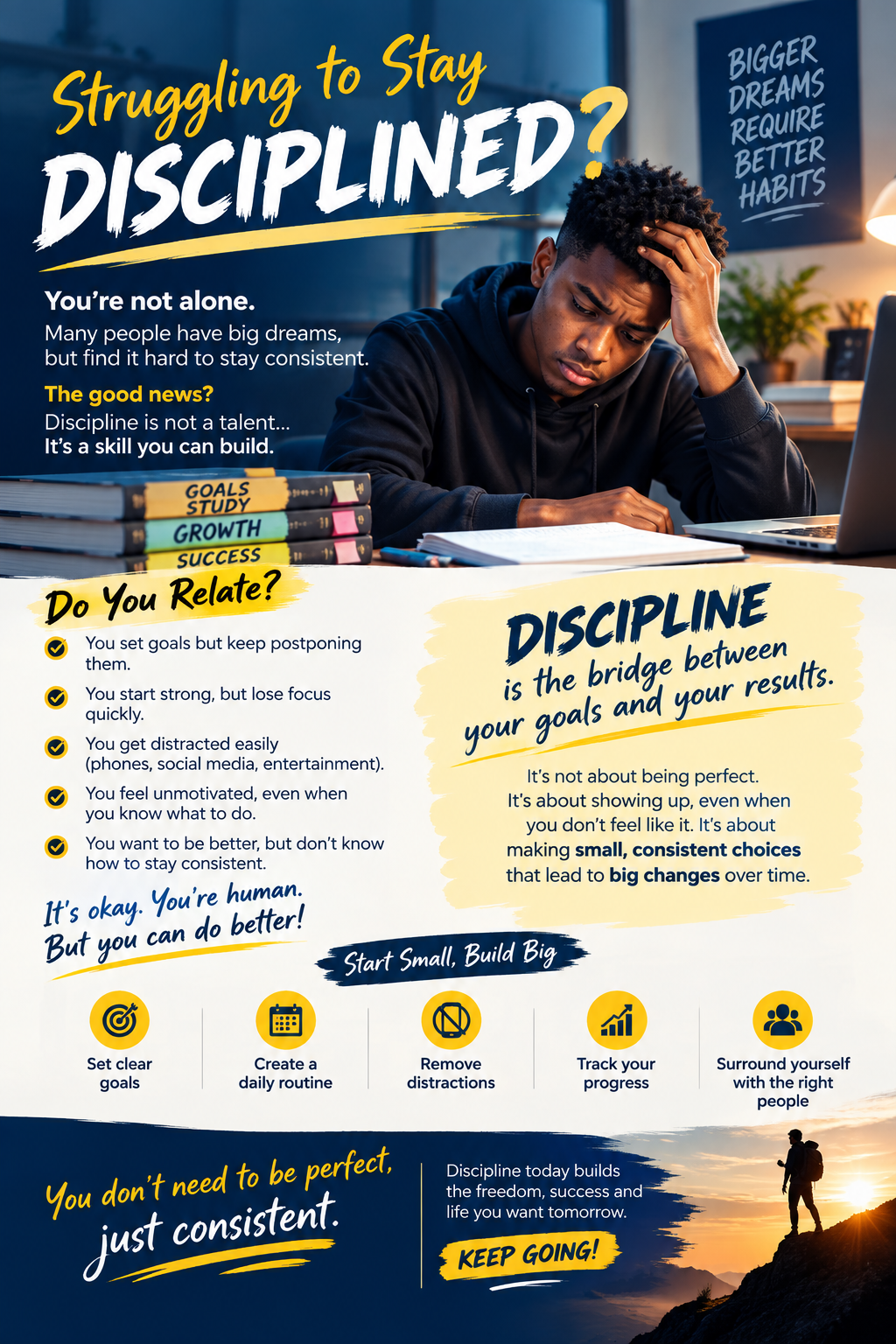
DISCIPLINE: HOW TO BUILD SELF-DISCIPLINE AND ACHIEVE YOUR GOALS
Discipline is one of the most important habits for personal growth, academic success, career development, and achieving long-term goals. While motivation can help you start, self-discipline is what helps you continue when motivation disappears.
Many people have dreams, goals, and plans, but not everyone develops the discipline needed to turn those plans into reality. Learning how to build self-discipline can help you become more consistent, focused, productive, and responsible in everyday life.
What Is Discipline?
Discipline is the ability to control your actions, thoughts, emotions, and habits so they align with your goals. It means doing what needs to be done, even when you do not feel like doing it.
Discipline is not punishment. Instead, it is a tool that helps you turn your intentions into results. It allows you to stay committed to your goals when distractions, difficulties, tiredness, or temporary setbacks appear.
A disciplined person does not depend entirely on mood or motivation. They study, work, exercise, complete tasks, and keep their commitments because they have made a decision to do so.
This is one reason self-discipline and consistency are important for long-term success. Having a goal is only the beginning. Taking action repeatedly is what moves you closer to that goal.
Why Is Self-Discipline Important?
Self-discipline helps you take control of your time, habits, decisions, and priorities. It can improve productivity and help you remain focused on what matters most.
Whether you are a student preparing for examinations, a young professional building a career, an entrepreneur developing a business, or simply someone working on personal growth, discipline can help you stay consistent.
Discipline helps you:
– Stay focused on your goals.
– Manage your time effectively.
– Avoid unnecessary distractions.
– Develop positive habits.
– Complete tasks on time.
– Improve productivity.
– Become more reliable.
– Build confidence and self-trust.
– Handle setbacks without giving up.
– Make progress toward long-term goals.
Types of Discipline
Discipline is not limited to school or work. It appears in different areas of everyday life.
1. Self-Discipline
Self-discipline means controlling your own behavior, habits, time, and emotions without constantly needing someone else to push you.
It is the foundation of many other forms of discipline.
2. Physical Discipline
Physical discipline involves maintaining healthy routines such as exercise, proper rest, good nutrition, and regular physical activity.
3. Mental Discipline
Mental discipline involves staying focused, controlling distractions, managing your attention, and continuing to work toward a goal even when the task becomes difficult.
4. Financial Discipline
Financial discipline involves budgeting, saving money, controlling unnecessary spending, and making responsible financial decisions.
5. Social Discipline
Social discipline involves respecting shared rules, responsibilities, values, and expectations within your family, community, school, workplace, or other social environment.
6. Corrective Discipline
Corrective discipline is used to guide or correct inappropriate behavior. It can be found in schools, workplaces, families, and other organized environments.
Understanding these different types of discipline shows that discipline affects almost every part of life.
How to Build Self-Discipline
Learning how to build self-discipline does not happen overnight. It requires a decision followed by consistent daily practice.
Start by setting clear goals. Know what you want to accomplish, why it matters, and what actions you need to take.
Create a routine that makes it easier to act consistently. Instead of asking yourself every day whether you feel like studying, exercising, working, or completing a task, establish a specific time for it.
You should also learn to manage distractions. Your phone, social media, entertainment, and other interruptions can easily take attention away from important tasks.
Most importantly, do not expect perfection. Discipline grows through repeated action. If you make a mistake or miss a day, return to your routine instead of abandoning your goal.
Why Discipline Matters for Success
Discipline is the bridge between goals and results. You can have excellent plans, but without consistent action, those plans may remain ideas.
Discipline Builds Self-Trust
Every time you keep a promise to yourself, you strengthen your confidence. Completing a task you committed to completing teaches you that you can depend on yourself.
Discipline Improves Productivity
A disciplined person is more likely to prioritize important tasks and reduce unnecessary distractions. This can make it easier to manage work, school, and personal responsibilities.
Discipline Creates Freedom
Good discipline can help you manage your time and resources more effectively. Instead of constantly reacting to problems, you can develop systems and routines that create greater control over your daily life.
Discipline Supports Personal Growth
Personal growth requires continuous learning and improvement. Discipline helps you keep practicing even when progress seems slow.
Discipline Builds Trust
People tend to value consistency. At school, at work, in business, and in relationships, being someone who keeps commitments and meets responsibilities can help build trust.
Discipline vs. Motivation
One of the most important lessons about discipline is understanding the difference between discipline and motivation.
Motivation is a feeling. Discipline is a decision.
Motivation can be powerful, but it can also change from one day to another. You may feel highly motivated on Monday and completely exhausted by Thursday.
If you depend entirely on motivation, your actions may become inconsistent.
Discipline helps you continue even when motivation is low.
This does not mean motivation is useless. Motivation can give you the energy to start, while discipline and habits can help you continue.
Instead of asking, “Do I feel motivated today?”, ask:
“What is the next action I need to take?”
That simple change in thinking can make a major difference.
7 Simple Ways to Build Self-Discipline
1. Set Clear Goals
You cannot consistently work toward a goal that is unclear.
Write down what you want to achieve, why it matters, and when you want to achieve it. Clear goals give your daily actions direction.
2. Start Small
Do not try to transform your entire life in one day.
Start with small actions. Read for ten minutes. Write one page. Exercise for five minutes. Study one topic.
Small actions repeated consistently can develop strong self-discipline habits.
3. Create a Daily Routine
A daily routine reduces the number of decisions you have to make.
When you know when you will study, work, exercise, rest, or complete important tasks, it becomes easier to remain consistent.
4. Remove Distractions
Your environment can either support or weaken your discipline.
If your phone constantly distracts you while studying, put it away. If social media consumes your productive hours, create boundaries.
Do not depend only on willpower. Make it easier to do the right thing.
5. Track Your Progress
Use a notebook, calendar, checklist, or habit tracker to monitor your progress.
Tracking your actions can help you see whether you are actually becoming more consistent.
6. Learn From Failure
You will sometimes miss a day, make a mistake, or fail to complete a task.
That does not mean you have failed completely.
Learn from the setback and return to your routine. One bad day should not become a reason to abandon a long-term goal.
7. Surround Yourself With Disciplined People
Your environment influences your habits.
Spend time with people who take their education, careers, responsibilities, and goals seriously. Positive environments can encourage positive behavior.
How Long Does It Take to Build Discipline?
There is no fixed number of days required to develop discipline.
Some habits may become easier after several weeks of consistent practice, while more significant behavioral changes may require much longer.
The important factor is consistency.
Do not focus only on how quickly you can become disciplined. Focus on whether you are taking meaningful action repeatedly.
Small progress every day is more valuable than occasional bursts of effort.
Common Discipline Mistakes to Avoid
When trying to develop self-discipline, avoid these common mistakes:
– Trying to change everything at once.
– Depending only on motivation.
– Setting unrealistic goals.
– Comparing your progress with other people.
– Allowing one failure to become a reason to quit.
– Ignoring the importance of sleep and rest.
– Spending too much time on distractions.
– Creating complicated routines that are difficult to maintain.
– Focusing only on results instead of daily habits.
Discipline should help you build a sustainable lifestyle, not create unnecessary pressure.
Discipline for Students and Young Professionals
Discipline for students is particularly important because academic success requires regular effort.
Consider two students who begin university with similar goals.
The first student waits until examinations are close before studying. They skip classes when they are tired, postpone assignments, and depend on last-minute motivation.
The second student creates a study routine, attends classes regularly, reviews notes, completes assignments on time, and prepares gradually for examinations.
The difference may not be intelligence. It may simply be consistency and discipline.
The same principle applies to young professionals.
A professional who arrives on time, meets deadlines, develops new skills, and consistently performs their responsibilities can build a reputation for reliability.
In both education and employment, small disciplined actions can produce significant results over time.
Discipline, Habits, and Personal Growth
Discipline and habits are closely connected.
At first, an action may require conscious effort. However, repeated actions can gradually become part of your routine.
For example, studying every evening may initially feel difficult. After consistent practice, sitting down to study at that time can become a normal part of your day.
This is why building good habits is an important part of personal development.
Instead of trying to rely on motivation every day, create routines that make positive behavior easier to repeat.
Discipline and Goal Setting
Effective goal setting gives discipline a clear direction.
A goal tells you where you want to go. A plan tells you what to do. Discipline helps you follow the plan.
For example, saying:
“I want to improve my academic performance”
is a good intention, but it is not enough.
A more practical approach could be:
– Study for one hour every evening.
– Review class notes after lectures.
– Complete assignments before the deadline.
– Practice difficult topics every weekend.
– Reduce unnecessary phone use during study sessions.
These small actions turn a general goal into a daily system.
The Relationship Between Discipline and Success
Success rarely comes from one major action. In many situations, it develops through repeated decisions and consistent effort.
Discipline helps you continue working when progress is slow.
It helps you keep learning when something is difficult.
It helps you save when spending is tempting.
It helps you study when entertainment is more attractive.
It helps you keep your commitments when nobody is watching.
That is why discipline, consistency, productivity, and goal setting are powerful elements of personal growth.
Conclusion: Discipline Turns Goals Into Results
Discipline is not a gift reserved for a few people. It is a skill that can be developed through practice.
You do not need to become perfect before you begin. Start with one goal. Build one positive habit. Create one simple routine. Remove one major distraction. Then repeat the process.
When motivation disappears, discipline can keep you moving.
When progress feels slow, consistency can keep you going.
When failure happens, discipline can help you start again.
Whether you are a student, young professional, entrepreneur, leader, or someone working toward personal growth, developing self-discipline can help you turn intentions into meaningful results.
Do not wait until you feel motivated. Start with discipline, remain consistent, and let your daily actions move you toward the person you want to become.