

Currently Empty: 0 CFA
Idriss Adam — Educational Content & Leadership Development
The Quiet Strength Behind a Good Life
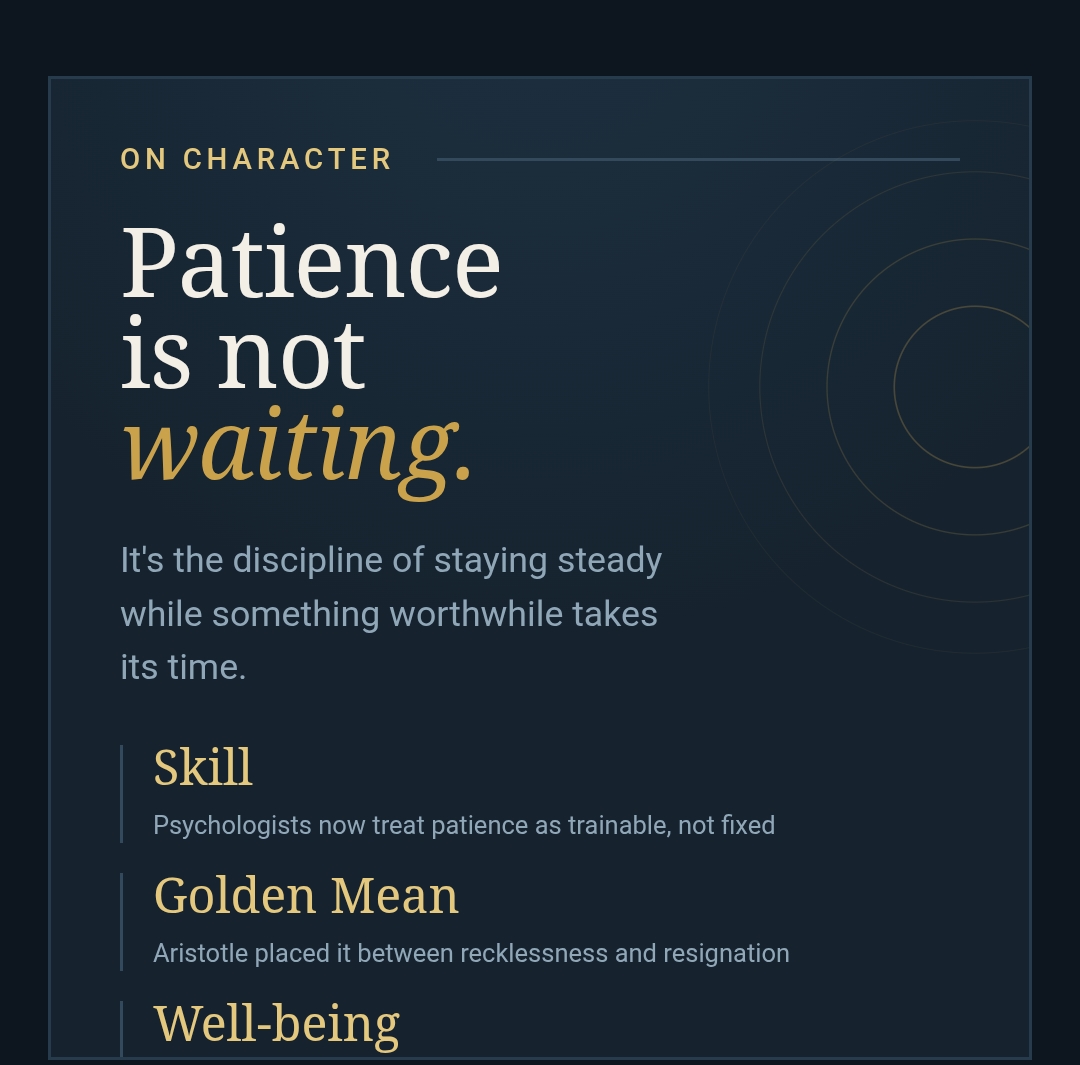
Patience
By Adamu Issa
We live in a time that rewards speed. Food arrives in minutes, messages are answered in seconds, and success is expected almost overnight. In this kind of world, patience can look old-fashioned, even weak. Yet research from psychology, philosophy, and everyday human experience keeps pointing to the same truth: patience is not weakness. It is one of the most useful and powerful qualities a person can build. This article looks at what patience really is, what science and philosophy say about it, why it matters, and how anyone can grow more of it.
What Patience Really Means
Patience is often described simply as the ability to wait calmly. But researchers who study it define it more precisely. One review of the psychological literature describes patience as the capacity to endure delay, difficulty, or suffering without becoming upset or anxious, and treats it as a skill tied to emotional regulation and long-term decision-making rather than a fixed personality trait (University of Juiz de Fora, gv.ufjf.br).
This idea has deep roots in experimental psychology. Walter Mischel’s well-known studies on delayed gratification, sometimes called the “marshmallow test,” found that children who could resist a smaller, immediate reward in order to receive a larger one later tended to show stronger self-control and better outcomes later in life. That line of research helped establish patience as something measurable, not just a moral idea (University of Juiz de Fora, gv.ufjf.br).
More recent psychology has pushed the definition further. Kate Sweeny, a psychologist at the University of California, Riverside, and her colleagues developed what they call the “process model of patience.” Their research, published in Personality and Social Psychology Review, argues that impatience is its own emotion, triggered when a situation takes longer to resolve than feels reasonable, and that patience is best understood as a coping strategy people use to manage that frustration, rather than simply a virtue some people have and others do not (British Psychological Society Research Digest, bps.org.uk).
Psychologist Sarah Schnitker of Baylor University, whose work blends psychology, theology, and philosophy, adds that patience helps people regulate emotion, stay calm, and keep working toward goals even when progress is slow. She also points out that patience is not the same as being passive: a patient person can still be assertive and can still pursue justice. As she puts it, being a doormat is not a sign of patience but a lack of assertiveness (Yale Faith and Work Initiative interview, faith.yale.edu).
Patience in Philosophy
Long before psychologists studied patience in laboratories, philosophers wrote about it as a mark of a well-lived life. The Greek philosopher Aristotle, in the Nicomachean Ethics, described virtue as a “golden mean” between two extremes. Applied to patience, this means the virtuous position sits between reckless impatience on one side and passive resignation on the other. A person of good character bears hardship not because they cannot feel it, but because of strength of spirit and generosity of character (Aristotle, Nicomachean Ethics, cited via sententiaeantiquae.com).
The Roman Stoic philosopher Seneca wrote extensively about self-control and endurance. He observed that a thing which patience could gently unravel is often torn apart by a violent tug, warning against forcing outcomes before their time (Seneca, De Beneficiis, cited via sententiaeantiquae.com). Elsewhere, Seneca linked patience directly to emotional control, noting that the greatest remedy for anger is delay, a reminder that waiting even a short while can prevent regret (Seneca, cited via getstoic.com). The ancient Roman writer known through the Dicta Catonis went further still, calling patience the greatest virtue of humankind (Dicta Catonis, cited via sententiaeantiquae.com).
Why Patience Matters
Mental health and well-being: Research summarized by Yale’s Faith and Work Initiative notes that patience plays an important role in managing life’s stresses, is linked to a greater sense of well-being, and is even associated with lower rates of depression and suicide risk (faith.yale.edu).
Better decisions: Because patience involves resisting the pull of an immediate reward, it supports more thoughtful, long-term decision-making rather than reactive choices made in the heat of the moment (gv.ufjf.br).
Stronger relationships: Patience allows people to respond to conflict or delay with composure instead of frustration, which protects relationships that might otherwise be damaged by short tempers.
Resilience under pressure: Seneca compared hardship to physical training, arguing that difficulties strengthen the mind the way labor strengthens the body — a view echoed in modern resilience research that treats patience as a trainable capacity rather than a fixed trait (getstoic.com; gv.ufjf.br).
Patience Is a Skill, Not Just a Feeling
One of the most useful findings from recent psychology is that patience can be built. Kate Sweeny’s process model treats impatience as a normal emotional reaction to delay, which means patience is less about never feeling frustrated and more about how a person manages that frustration once it appears (bps.org.uk). This reframes patience from something a person simply “has” or “lacks” into a skill that can be practiced, much like a muscle grows stronger with consistent use.
Some practical ways to build patience include:
Naming the feeling: Recognizing impatience as it arises, instead of acting on it immediately, creates space to choose a calmer response.
Reframing delay: Viewing a wait as part of the process rather than an obstacle to it can reduce the frustration attached to it.
Practicing small waits: Deliberately choosing not to rush minor everyday moments, such as a slow queue or a delayed reply, builds the habit of tolerating discomfort without reacting.
Keeping the long-term goal in view: Remembering why a goal matters makes it easier to tolerate short-term setbacks in pursuit of it, in the same way children in Mischel’s studies held out for a better reward later (gv.ufjf.br).
Conclusion
Patience is not the absence of urgency, and it is not passivity. It is the disciplined ability to hold steady while working toward something worthwhile, even when the outcome is delayed or the path is difficult. Philosophers like Aristotle and Seneca praised it as a mark of strong character centuries ago, and modern psychology now confirms what they observed: patient people tend to make better decisions, build stronger relationships, and enjoy greater well-being. In a fast-moving world, choosing to be patient is not falling behind. It is choosing to build something that lasts.