

Currently Empty: 0 CFA
Wirnkar Glory — Career Development & Digital Skills
8 Digital Skills Every Cameroonian Student Should Learn Before Graduation
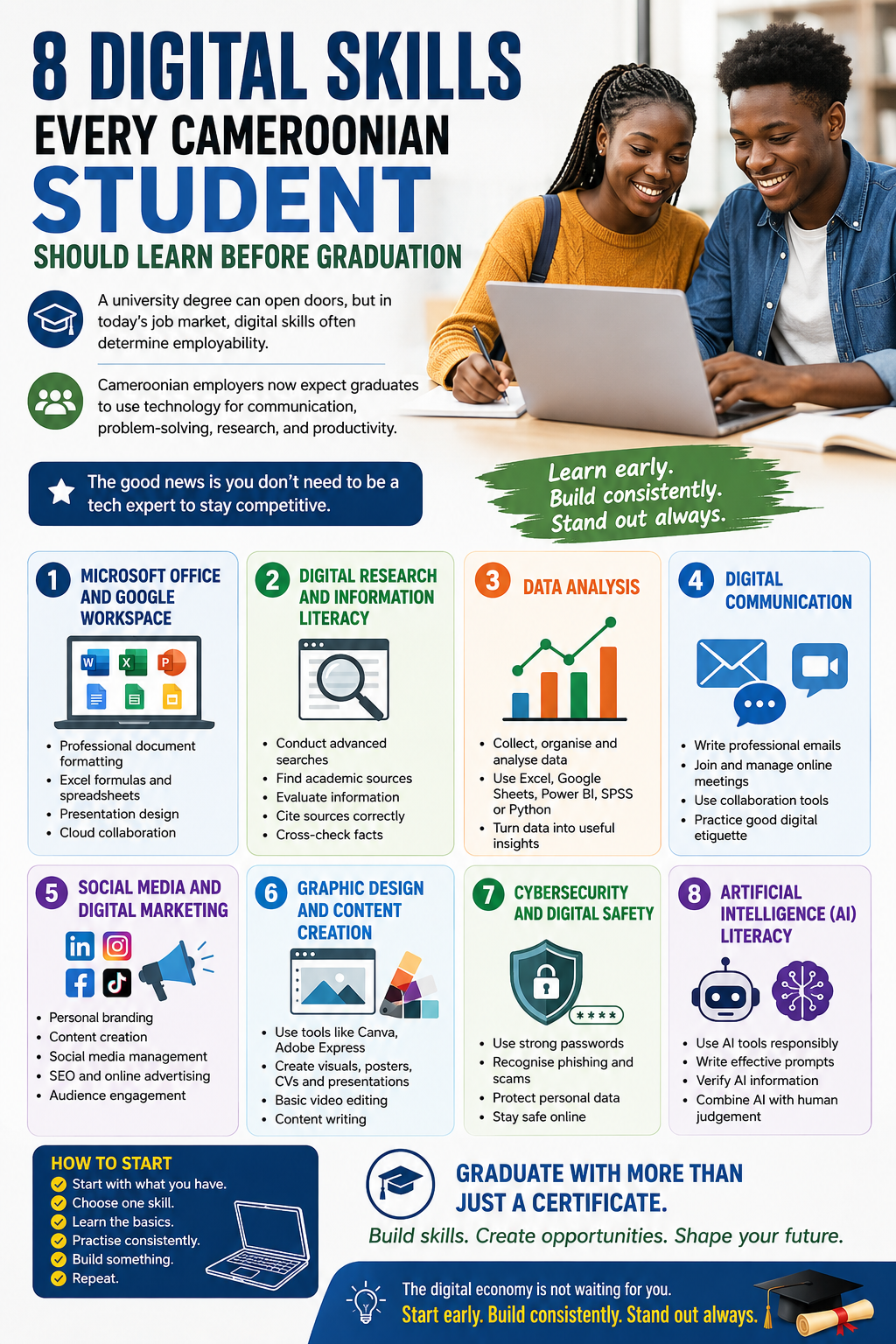
8 Digital Skills Every Cameroonian Student Should Learn Before Graduation
A university degree can open doors, but in today’s competitive job market, digital skills can determine whether a graduate walks through those doors or gets left behind. For Cameroonian students, this is more important than ever. Employers increasingly expect graduates to do more than present academic certificates. They want people who can use technology to solve problems, communicate effectively, analyse information, create content, manage projects, and adapt to new digital tools.
The good news is that students do not need to become computer scientists to remain competitive. Learning the right digital skills before graduation can significantly improve employability, entrepreneurship opportunities, and academic performance.
A university degree can open doors, but in today’s job market, digital skills often determine employability.
Cameroonian employers now expect graduates to use technology for communication, problem-solving, research, and productivity. The good news is you don’t need to be a tech expert to stay competitive.
Here are 8 digital skills every Cameroonian student should learn before graduation.
1. Microsoft Office and Google Workspace
Basic office software remains one of the most important digital skills for students and graduates. Students should be comfortable using Microsoft Word, Excel and PowerPoint, as well as tools such as Google Docs, Google Sheets and Google Slides. These skills are useful for writing reports, preparing presentations, analysing data, creating budgets, managing information and collaborating on group projects.
What to learn
Professional document formatting
Excel formulas and spreadsheets
Data sorting and filtering
Presentation design
Google Drive and cloud collaboration
Being able to use these tools efficiently can immediately make a graduate more productive in the workplace.
2. Digital Research and Information Literacy
The internet contains enormous amounts of information, but not all information online is reliable. Students should know how to search effectively, identify credible sources, verify information and use academic databases. This is particularly important when writing assignments, research papers, projects and dissertations. A digitally skilled student should be able to distinguish between credible evidence and misinformation.
Learn how to:
Conduct advanced Google searches
Find academic sources
Evaluate websites and online information
Cite sources correctly
Cross-check information before using it
This skill is useful far beyond university. It is a foundation for lifelong learning. Students should be comfortable with Word, Excel, PowerPoint, Google Docs, Sheets, and Slides.
These tools are essential for writing, presentations, data handling, and group work.
3. Data Analysis
Data is now used in almost every sector, including healthcare, banking, education, business, agriculture, engineering and government.
Students do not necessarily need to become data scientists. However, understanding how to collect, organise, analyse and present data can give them a major advantage.
Start with Microsoft Excel or Google Sheets, then progress to tools such as Power BI, SPSS, Python or other software relevant to your field.
A graduate who can turn raw data into useful information is valuable in almost any organisation. Basic data skills using Excel or Google Sheets help in organising and interpreting information across many fields.
4. Digital Communication
Knowing how to communicate professionally online is an essential workplace skill. Students should know how to write professional emails, participate in virtual meetings, use collaborative platforms and communicate appropriately on professional networks.
Digital communication also includes knowing when to use email, messaging applications, video calls or formal documents. Simple mistakes such as poor grammar, unclear emails or unprofessional online behaviour can damage a student’s professional image.
Learn to communicate clearly, professionally and respectfully online. Professional email writing, online meetings, and proper digital etiquette are key workplace skills.
5. Social Media and Digital Marketing
Social media is not only for entertainment. It has become a powerful tool for business, personal branding, networking and employment. Cameroonian students can use platforms such as LinkedIn, Facebook, Instagram and TikTok to showcase their skills, promote businesses, build professional networks and discover opportunities. Students interested in entrepreneurship should also understand basic digital marketing.
Important areas include:
Personal branding
Content creation
Social media management
Search engine optimisation (SEO)
Online advertising
Audience engagement
Your social media presence can become part of your professional identity. Use it strategically. Platforms like LinkedIn and Instagram can be used for branding, networking, and business promotion.
6. Graphic Design and Content Creation
You do not need to be a professional designer to benefit from graphic design skills. Learning tools such as Canva, Adobe Express or similar platforms can help students create professional presentations, posters, CVs, social media graphics, flyers and promotional materials. Content creation is also increasingly valuable for businesses and organisations.
A student who can write, design and produce basic digital content can create opportunities for freelance work while still in school. Start small. Learn design principles, visual communication, basic video editing and content writing.
7. Cybersecurity and Digital Safety
As students become more dependent on technology, they also become targets for cybercrime. Every student should understand basic cybersecurity practices. Learn how to create strong passwords, recognise phishing messages, secure accounts, protect personal information and avoid suspicious links and downloads.
Students should also understand the risks of sharing sensitive information online. Never assume that a message, website or job offer is legitimate simply because it looks professional.
Digital literacy without digital security can leave you vulnerable.
Students should learn how to protect accounts, avoid scams, and secure personal data online.
8. Artificial Intelligence (AI) Literacy
Artificial intelligence is changing education and the workplace rapidly. Students should learn how to use AI tools responsibly to improve productivity, research, brainstorming, writing, coding, data analysis and learning. However, AI should be treated as a tool and not a replacement for thinking.
Students need to understand how to:
Write effective prompts
Verify AI-generated information
Protect confidential information
Use AI ethically
Identify inaccurate or fabricated answers
Combine AI assistance with human judgement
Graduates who understand how to work effectively with AI will have an advantage in the job market. But succeeding online requires more than creating an account.
Students should learn how to:
Build a professional portfolio
Create a strong CV
Write proposals
Communicate with clients
Price their services
Meet deadlines
Protect themselves from online scams
The goal should not simply be to “make money online.” The goal is to develop a valuable skill that can generate income and professional experience.
How o Start
Start with the smartphone or computer you already have. Choose one skill, learn the basics, practise consistently and build something with what you learn.
Learn. Practise. Build. Repeat.
That is how digital knowledge becomes a real-world skill.
Graduation should not be the moment when a student starts thinking about employability. Preparation should begin long before the final examination.
The digital economy is not waiting for graduates to catch up. Start by learning early, build consistently, and graduate with more than just a certificate.
Find attached links to some of my articles below
1. https://acadexcognitive.com/effective-communication-as-an-essential-professional-tool/
Godwill Yakum
Great
Wirnkar Glory Ghanyen
Thank you Sir 🙏🏾
Yenfola Celine Binnyuy
Wow this is great girl👍
Keep up👏👏
Wirnkar Glory Ghanyen
🫠
Claude
Awesome
Wirnkar Glory Ghanyen
Thank you 🙏🏾